Why 60% of users stayed undecided, and the comparison tool that went on the roadmap.
Role
UI/UX Designer, solo
Timeline
3 months
What I did
User Research
User Interviews
User Testing
Qualitative Analysis
Prototyping
Why 60% of users are undecided between career advancement and a career switch, and how that hurts conversion.
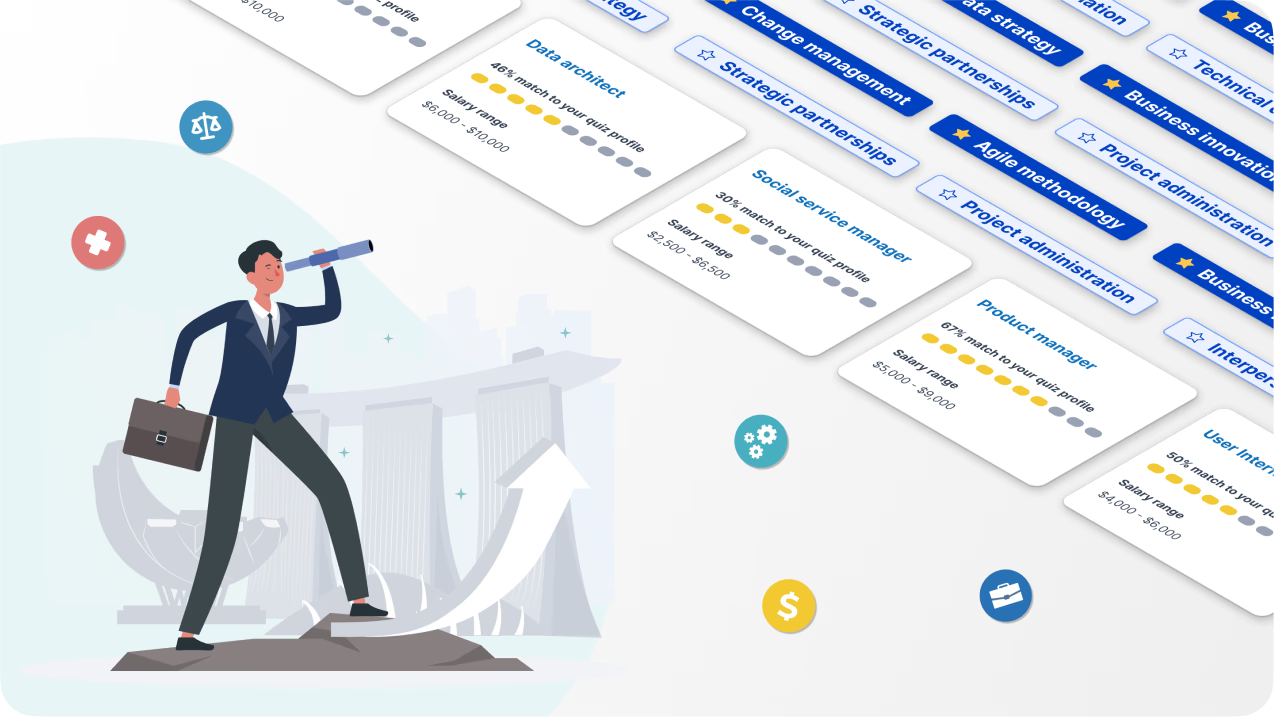
CareersFinder (CF) is a MyCareersFuture product that matches users to career opportunities via a short quiz. When users choose "open to both" instead of a clear path, results become less relevant, which weakens match quality and the likelihood they take action. During my internship at GovTech Singapore, I ran this research and prototype solo to understand that "broad middle" and how CF could better serve them.
User research and conversion blockers
I ran in-depth interviews across different age groups and sectors. Despite that spread, consensus emerged early: the same core themes surfaced in every session. A common theme was the need for more clarity and support before making career decisions. That uncertainty showed up as conversion blockers in testing:
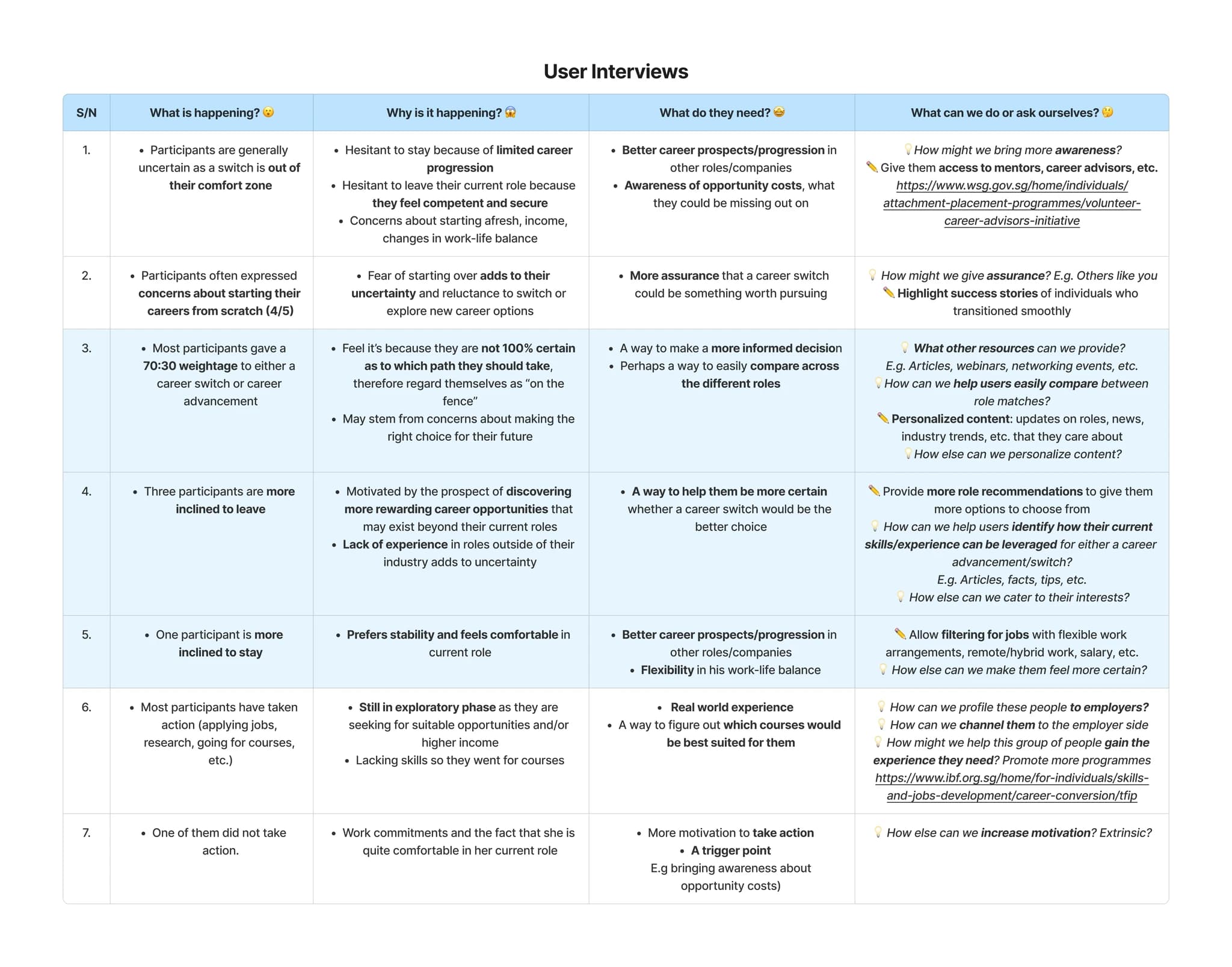
User interview findings synthesised into what was happening, why, what users needed, and what we could ask next
Uncertainty and comfort zones: Participants were hesitant about a career switch (comfort zone, work-life balance) but also hesitant to stay due to limited progression, so they leaned "open to both" and got less relevant matches.
Preference and fear of starting over: Most gave a 70:30 weight to switch vs advancement and saw it as a high-stakes decision. Worry about starting from scratch added to indecision and reluctance to act on results.
Irrelevant match results and mixed opinions on the skills match score; weaker relevance reduces the chance users act on recommendations.
The product felt too broad with limited quiz inputs (e.g. job role and skills), so the product couldn’t deliver enough depth to support decision-making.
Solution: comparison tool
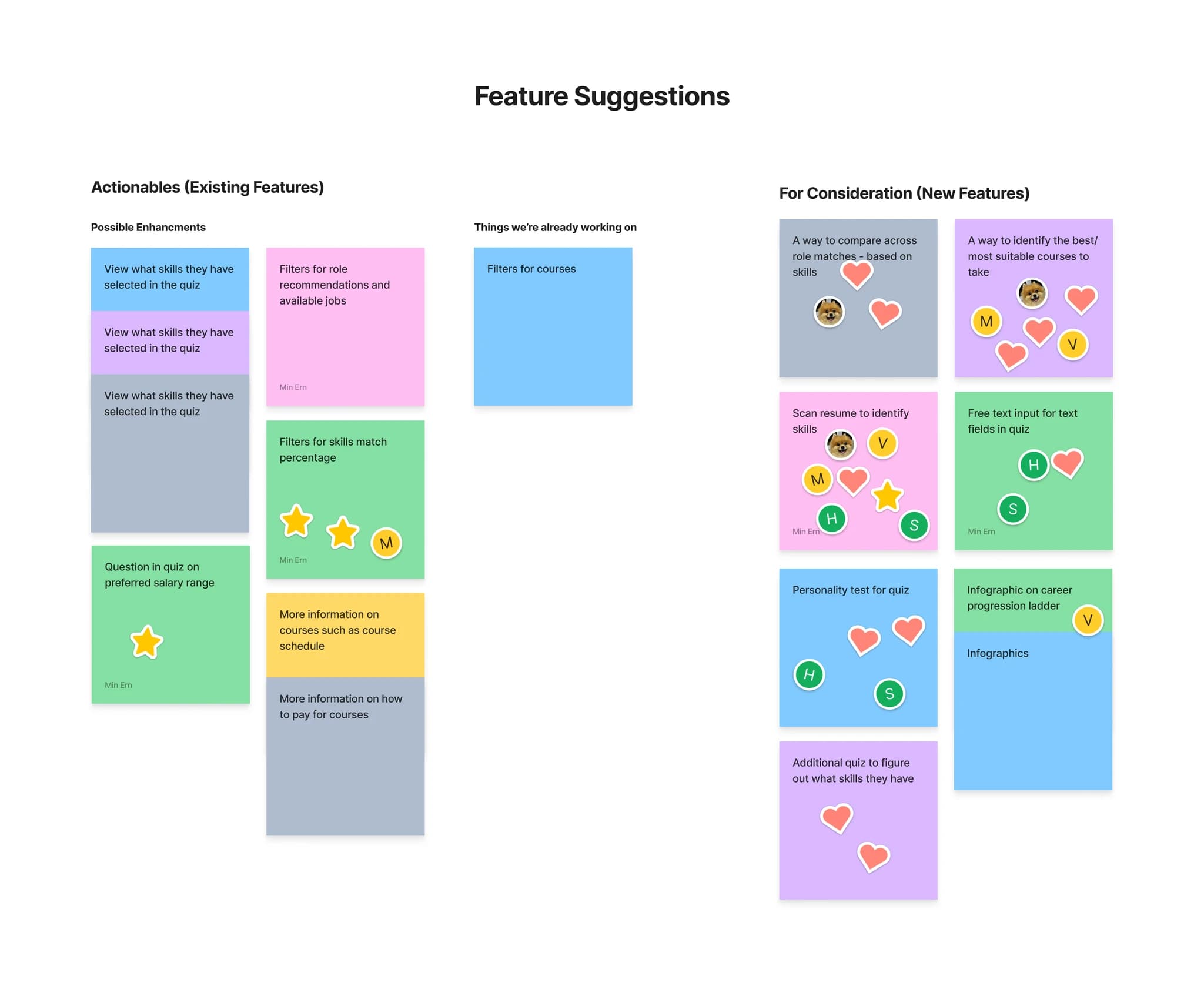
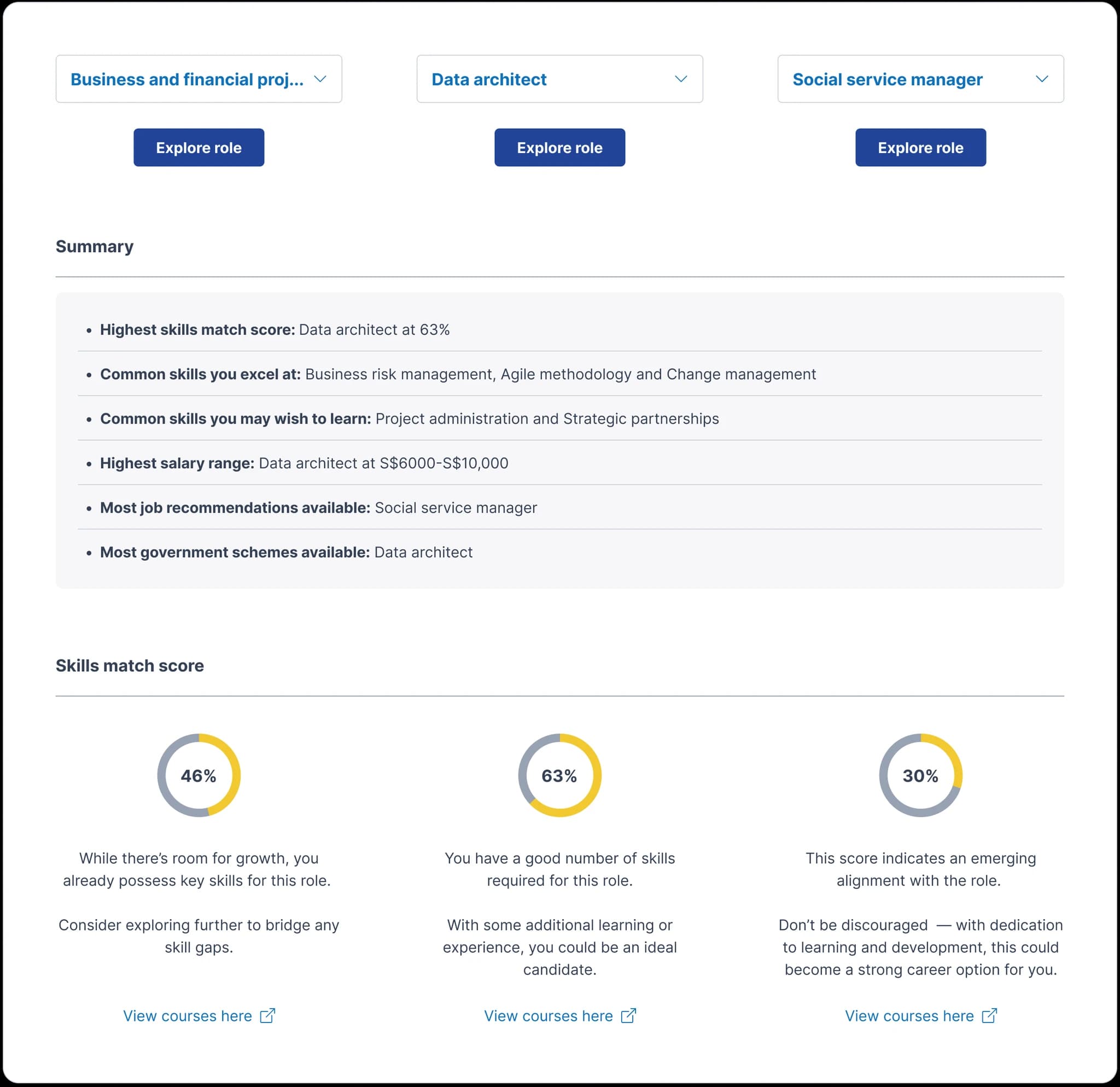
Findings were transcribed and synthesised on FigJam; stakeholders voted on priorities. The comparison tool ranked highest because it directly addressed the top conversion blocker: irrelevant results from vague intent. I created a persona to anchor design decisions and took on the comparison tool mockup (desktop and mobile). The tool has two parts: (1) Skills comparison (skills required across career options) and (2) Job information (salary and government grants).
FigJam feature suggestions board after synthesis, with the comparison tool rising as a priority among enhancements and new ideas
I placed job information below skills comparison so users see skills first and can reflect on fit before salary, reducing decision friction. The yellow donut at the top of each role acts as a clear focal point when discovering the tool.
Comparison tool prototype with skills match donuts across three roles, plus a summary of common skills, salary, and job volume
Results
Deliverables: research synthesis and persona, prioritised feature set, and a comparison tool prototype. Stakeholders adopted the persona and mockups for later design and product work. The comparison tool, additional filters, and access to career coaches were added to the team's roadmap. I later built JobFinder, a job search app whose primary flow is the side-by-side comparison this research identified, to carry the idea through to working code.
Takeaways
The input was vague, not the matching
It is tempting to read "irrelevant results" as a matching problem and go tune the algorithm. The interviews put it earlier in the chain: users picking "open to both" were telling the quiz almost nothing, so the results had little to work with. Fixing what the product could capture about intent mattered more than fixing what it did with the answer.
Saturation arrives before the budget expects
I recruited deliberately across age groups and sectors expecting the themes to diverge. They did not: the same concerns surfaced in every session, early. With a limited incentive budget that is the useful finding, because it means depth per participant and combining interviews with user testing beats spending the same money on more people.
Bring engineering in before the idea is finished
The comparison tool was non-standard for the product, so feasibility was a real risk rather than a formality. Working with content and engineering from the start is what kept it moving in one direction, and it is why the tool reached the roadmap as something buildable rather than as a nice mockup.